What is
Apple Immersive Video?
Apple Immersive Video 101 for Creators and Publishers
© Apple
Summary
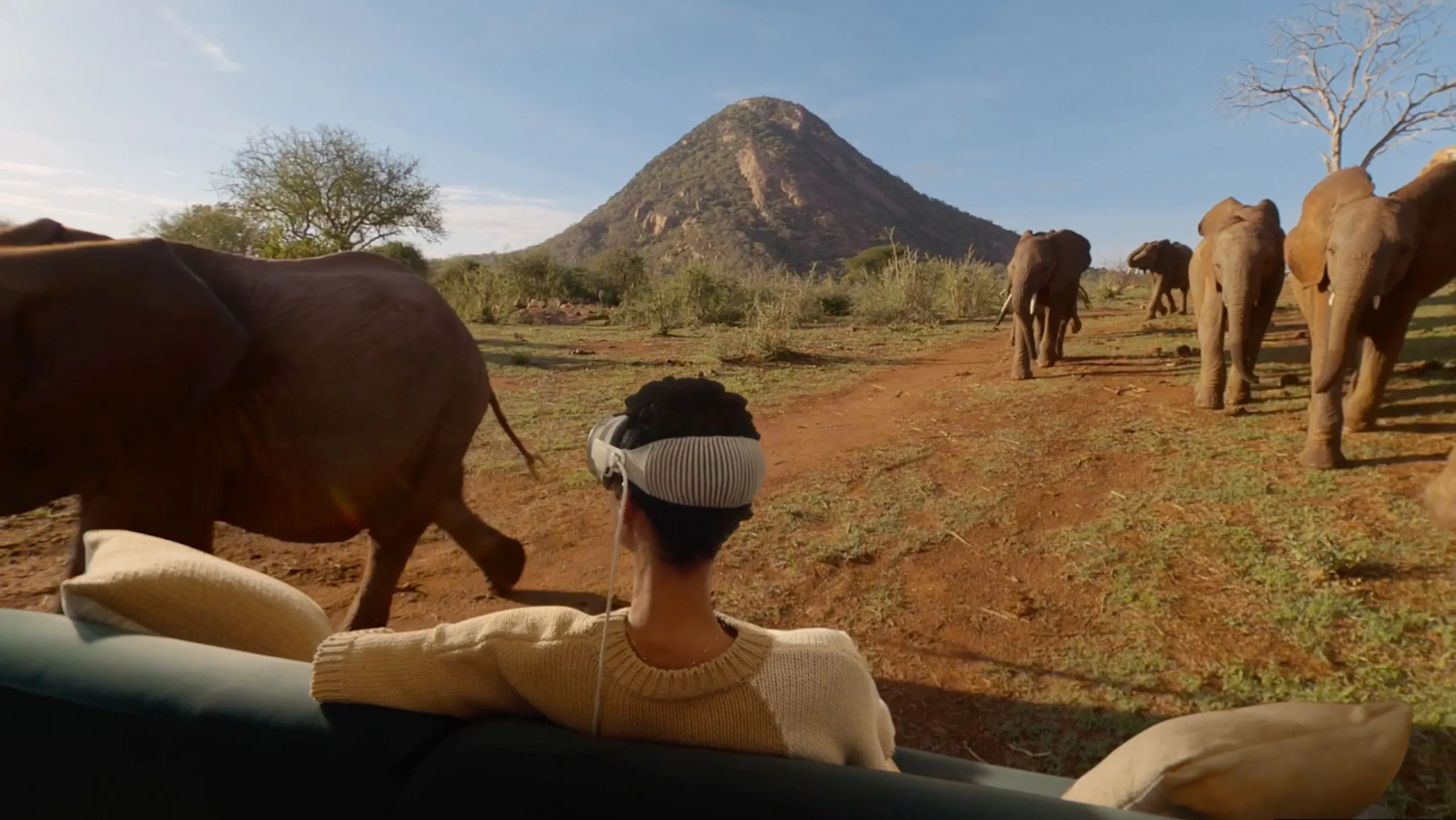
Apple Immersive Video (AIV) is a new format designed to mimic human 20/20 vision. It was introduced with the Apple Vision Pro in 2024.
Combined with Spatial Audio, Immersive Video creates the sensation of being physically present in the scene, rather than looking at a screen.
Examples
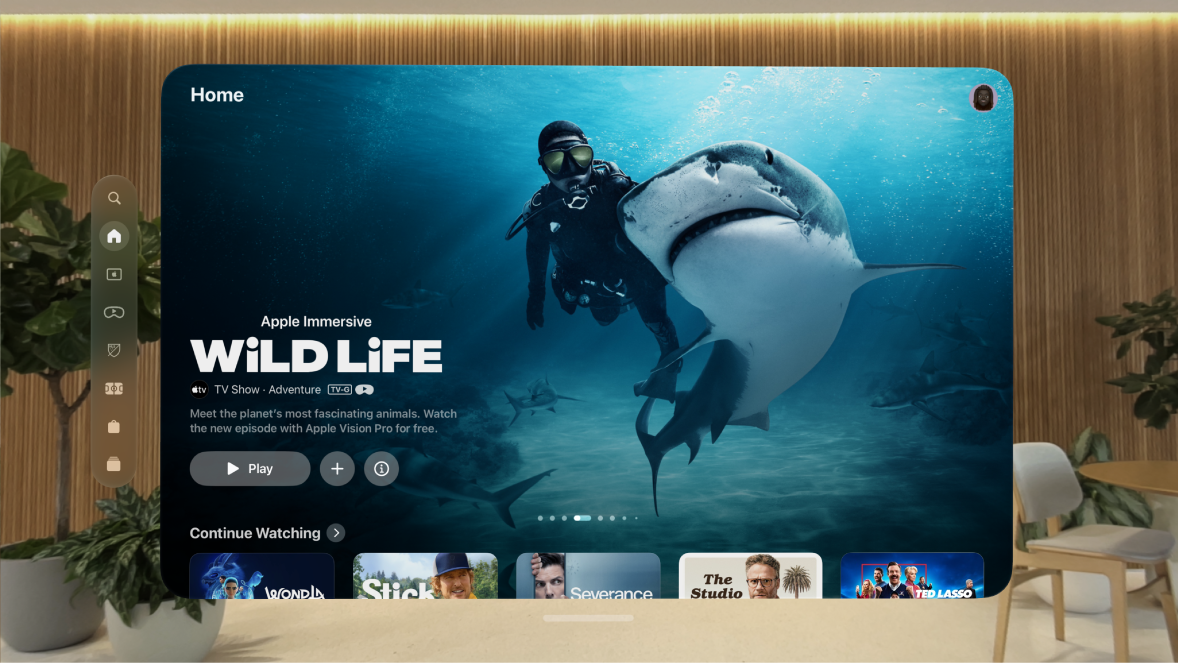
Some of the best examples are available in the visionOS Apple TV app under a dedicated “Immersive” tab.
Apple commissioned and produced a number of high quality series and standalone shows such as documentaries (Adventure & Wild Life), music (Alicia Keys: Rehearsal Room, The Weeknd: Open Hearts & Metallica), sports (MLS Cup Highlights & MotoGP: Tour de Force) and fiction (Submerged).
Capture
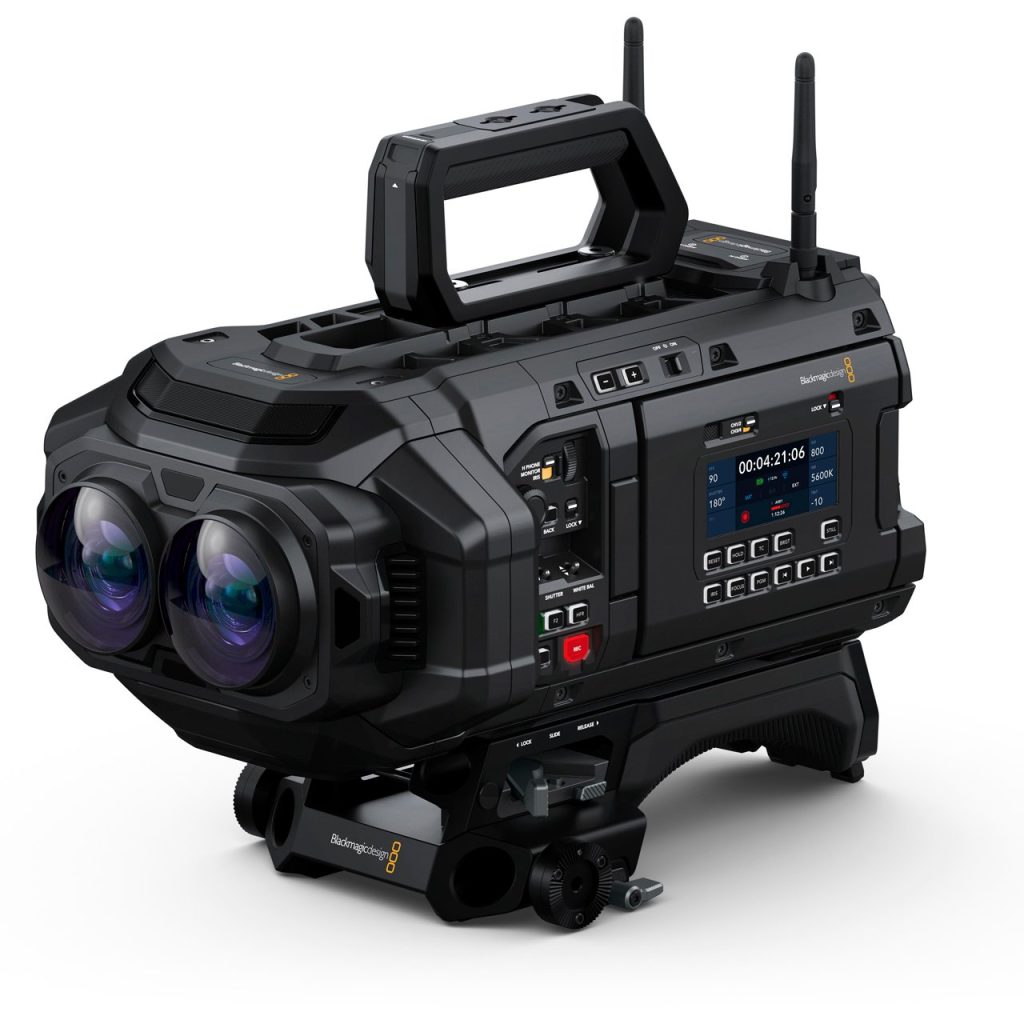
At of 2026, the only commercially available camera for AIV capture is the $33,000 Blackmagic URSA Cine Immersive. It is an all-in-one camera with fixed lenses that delivers a single file that’s kept through the whole post-production flow all the way to encoding and delivery.
Most AIV in Apple TV was captured with an Apple prototype camera, which is not available to the public. Some closeup scenes were shot with dual cameras mounted on a Stereotec beam-splitter rig.
AIV can also contain CG/VFX rendered with characteristics mimicking the lens configuration of the Blackmagic immersive camera.
Audio capture can be done with any combination of ambisonic and various mono lavalier or shotgun microphones, to be connected to the camera with a field recorder like the Zoom F6.
Specifications
👉 Keep in mind that AIV is a format for both capture and delivery!
The minimum capture requirements for AIV are very high:
- 180 degrees of field of view
- stereoscopic (i.e. one image per eye)
- 7200×7200 pixels per eye
- 90 frames per second
- HDR
AIV delivery requirements are identical, except the resolution per eye, which is 4320×4320.
Workflow
The AIV workflow is optimized to integrate with Blackmagic’s DaVinci Resolve Studio. It strives to make it easy for professional filmmakers used to traditional 2D video workflow, and streamline the complexities of legacy VR video workflows. There is a thorough workflow guide PDF on their support website.
👉 Apple’s “Create immersive media experiences for visionOS” event (recording, notes) is a great source of information on workflows for production and post-production.
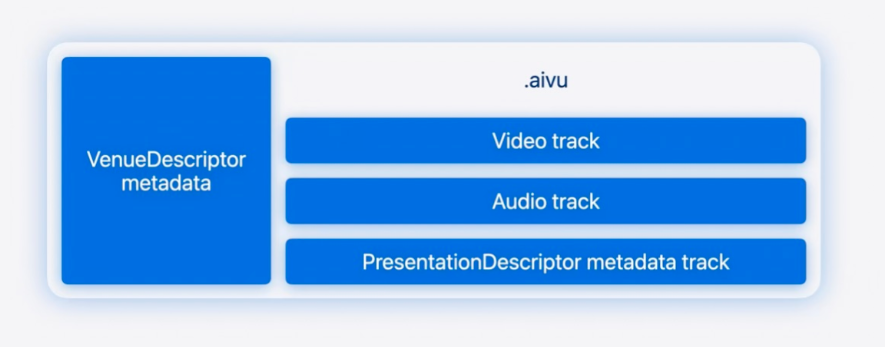
AIV is a “compound format” that assembles a number of elements under the hood: all AIV files build in video, audio, and other metadata. But there’s a subtility: AIV comes in two flavors, one for capture (production), and one for delivery (distribution).
Production AIV files are huge (terabytes), mostly because they package video data in RAW (such as Blackmagic .braw) or intermediary formats (such as QuickTime ProRes .mov). They embed all raw audio sources. They can also include multipart VFX in .exr or full on .usdz 3D models to use as immersive environments, to replace the black edges of the screen.
Delivery AIV files (or .aivu) are big (tens of gigabytes): they compress video into MV-HEVC, an efficient way to pack stereo imagery. Similarly, their audio and metadata tracks are compressed from the raw sources in the production AIV. Those files can be AirDropped to Apple Vision Pro to be read natively, they can also be uploaded to the Acute Platform CMS to be distributed via streaming, privately or in a visionOS app.
Distribution
We created the Acute platform to help publishers (and media creators at large) show, share and sell their Immersive Videos. Today, you can create an account for free, find a list of our features and read our documentation and recommended export settings.
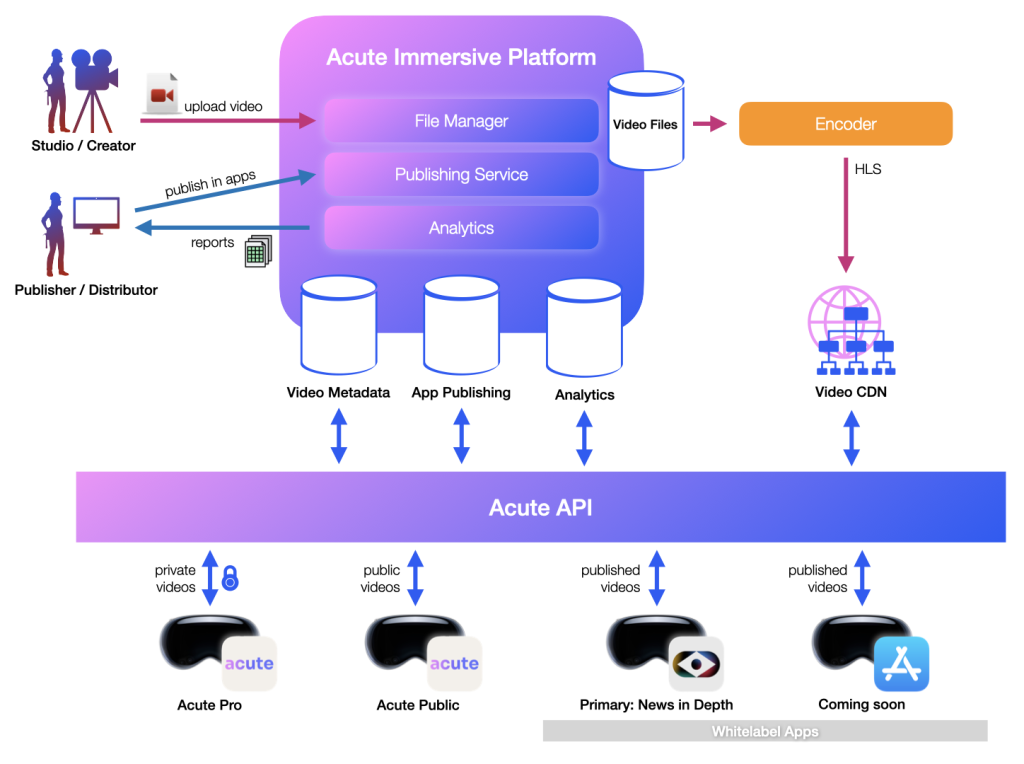
This schema summarizes the way our platform works:
- A studio or publisher uploads their assets on Acute (video file and metadata such as thumbnails, posters, text summary and credits)
- Acute encodes and hosts the video files and delivers them through an API to a suite of apps on Apple Vision Pro (either the Acute Pro app, or whitelabel/client applications)
- Finally, the content publisher receives data analytics from the apps and videos, including In-app page views, number of video plays and completion rate.
FAQs
What is the difference between Apple Immersive Video and VR180 or other VR formats?
It’s the metadata: 3D VR180 is a side-by-side half-equirectangular video and that’s it. The player must assume this is how the pixel are laid out, and render them accordingly.
AIV maintains the fisheye pixels of the original image, and embeds a lens calibration file (known as .ilpd). The image is undistorted and carries the metadata all the way from capture to playback, where it is reprojected dynamically for the viewer to optimize viewing comfort and acuity.
What is the difference between Apple Immersive Video and Spatial Video?
Spatial Video, also introduced with the Apple Vision Pro, is a rectilinear stereo format typically captured on iPhone. Spatial Video is primarily designed around ease of capture, for anybody to create 3D home videos and memories. Spatial Video typically captures around 70 degrees of field of view with a short interpupillary distance (IPD) of a few millimeters, in 1080p at 30FPS.
AIV is designed for professional productions, typically capturing around 180 degrees of field of view with a human-like IPD of 60mm, in 7200×7200 at 90FPS.